
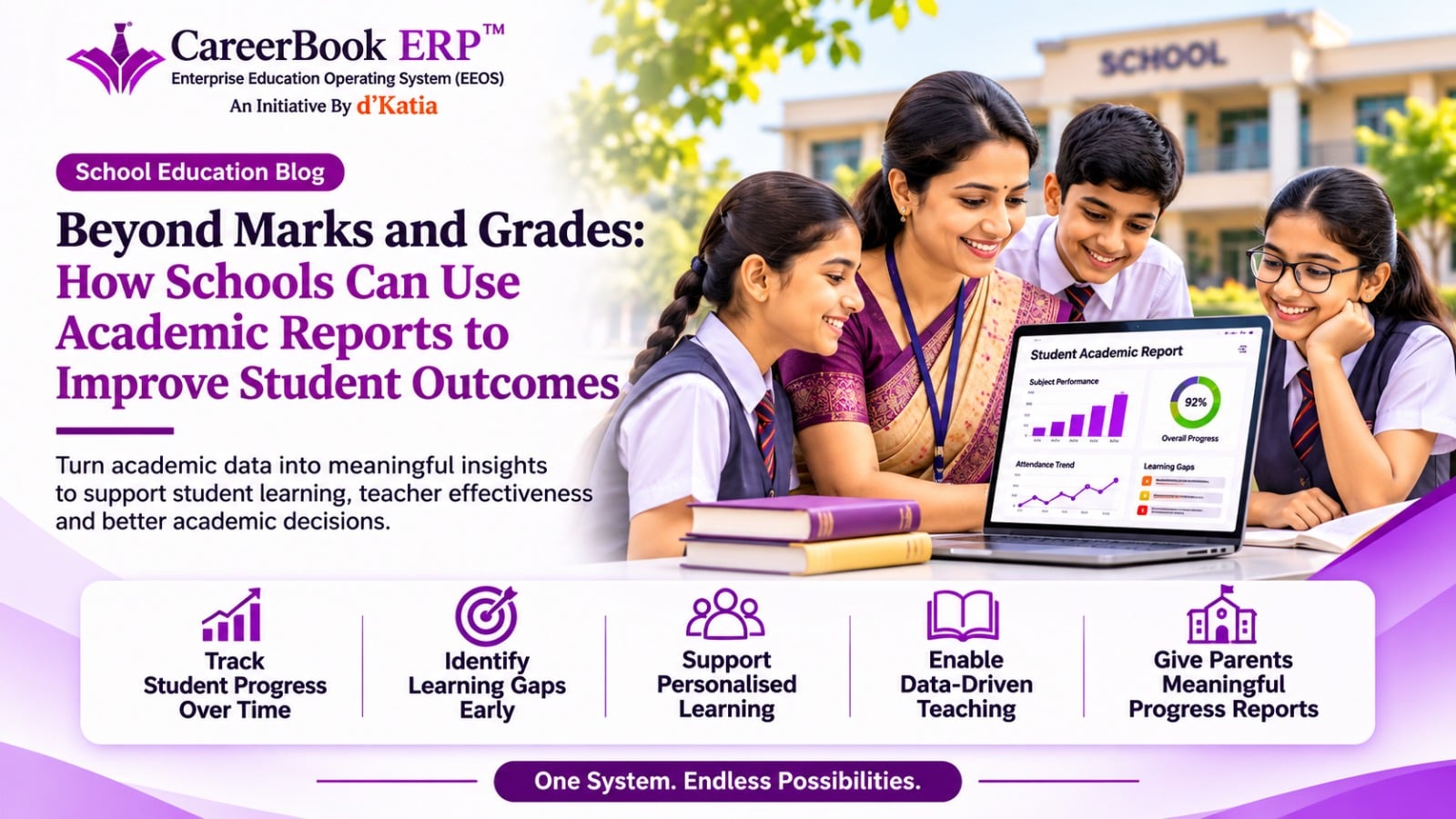
Beyond Marks and Grades: How Schools Can Use Academic Reports to Improve Student Outcomes
Why modern schools need meaningful academic insights, not just examination results.
Key takeaways
- Marks and grades are important, but they do not show progress, learning gaps or the support a student needs next.
- Useful academic reports combine subject-wise performance, progress over time, attendance, assessment trends and teacher observations.
- Connected reporting helps teachers, principals and parents act earlier and have more meaningful conversations.
- Reports are indicators, not automatic diagnoses: technology should support professional educational judgement, not replace it.
01Why Traditional Report Cards Are No Longer Enough
A conventional report card provides a summary of examination performance. While useful, it usually focuses on final results rather than the learning journey.
Consider two students:
Student A: Scored 90% in mathematics, compared with 96% in the previous examination.
Student B: Scored 72% in mathematics, compared with 48% previously.
Based only on current marks, Student A appears to be performing better.
However, Student B has demonstrated substantial improvement, while Student A's performance has declined.
A meaningful academic report should help teachers and parents understand both situations.
Modern reporting can provide information about:
- Academic progress across examinations and terms.
- Subject-wise strengths and weaknesses.
- Attendance patterns.
- Assignment completion.
- Continuous assessment performance.
- Areas requiring additional academic support.
- Improvement over time.
The objective is not to replace marks and grades but to make them more meaningful.
02What Makes an Academic Report Truly Useful?
An effective academic report should answer three essential questions:
- How is the student performing?
- Is the student improving?
- What support does the student need next?
To answer these questions, schools should consider combining different types of academic information.
Subject-wise performance
Reports should show performance in individual subjects rather than only overall percentages.
Progress over time
Teachers should be able to compare performance across assessments, terms and academic years.
Attendance and participation
Attendance patterns may provide additional context for academic performance.
Assessment trends
Class tests, assignments, projects and examinations can provide a more complete picture when considered together.
Areas for improvement
Reports should help identify topics or competencies requiring additional attention, where the institution collects sufficiently detailed assessment data.
Teacher observations
Qualitative feedback can explain important aspects of student progress that numbers alone cannot capture.
A useful academic report combines relevant information into a clear, understandable view.
03Identifying Learning Gaps Before They Become Serious Problems
One of the greatest advantages of structured academic reporting is the opportunity to identify learning difficulties earlier.
Imagine a student whose mathematics scores decline across three consecutive assessments.
Without comparative reporting, this pattern may not be immediately visible.
A progress dashboard could highlight the downward trend, encouraging the teacher to investigate possible reasons.
The teacher might then:
- Review the student's recent assessment work.
- Identify specific topics causing difficulty.
- Discuss learning challenges with the student.
- Provide additional practice or targeted support.
- Monitor progress in subsequent assessments.
This approach moves schools from simply recording performance to actively supporting improvement.
However, reports should be treated as indicators, not automatic diagnoses of a student's learning ability or needs.
04Connecting Attendance With Academic Performance
Attendance is an important part of school administration, but its value extends beyond maintaining daily registers.
When attendance and academic information are viewed together, teachers can investigate whether irregular attendance is affecting learning continuity.
For example, a report may reveal that a student with declining examination scores has also missed several classes.
This information helps the teacher ask better questions and determine what support may be appropriate.
Schools can use integrated reports to monitor:
- Monthly and term-wise attendance.
- Subject or class attendance patterns.
- Repeated absences.
- Academic performance alongside attendance.
- Students who may require follow-up.
Attendance data should always be interpreted carefully. Absences can have many causes, and schools should avoid making assumptions about individual students.
05Helping Teachers Make Better Academic Decisions
Teachers regularly collect valuable information through examinations, assignments, classroom activities and student interactions.
The challenge is turning this information into practical teaching decisions.
Academic dashboards can help teachers identify:
- Subjects or topics where students need additional support.
- Class-wide assessment trends.
- Students demonstrating significant improvement.
- Students whose performance requires closer attention.
- Differences between assessment periods.
- Pending assessment or reporting activities.
For example, if a large proportion of students performs poorly on a particular topic, the teacher may consider revisiting the concept, changing the teaching approach or providing additional learning resources.
Academic reporting becomes most useful when it informs classroom action.
06Giving Principals a Clear View of School Performance
School principals and academic coordinators need a broader perspective than individual student report cards.
They must understand academic performance across classes, grades, subjects and departments.
Without consolidated reporting, management teams may spend considerable time collecting information from teachers and preparing spreadsheets.
A centralised academic dashboard can provide a structured view of:
- Class-wise academic performance.
- Subject-wise result trends.
- Term-on-term comparisons.
- Attendance summaries.
- Assessment completion.
- Academic improvement patterns.
- Areas requiring management attention.
These reports can support academic review meetings, teacher planning and school improvement initiatives.
The purpose is not simply to compare teachers or classes. It is to understand where academic support, resources or changes may be needed.
07Making Parent–Teacher Meetings More Meaningful
Parent–teacher meetings are most effective when discussions go beyond individual examination marks.
A detailed academic progress report can help teachers explain:
- Where the student is performing well.
- Which subjects need improvement.
- Whether performance is improving or declining.
- How attendance and assignment completion are progressing.
- What parents can do to support learning at home.
Instead of discussing only a final percentage, teachers and parents can develop a shared understanding of the student's progress.
Clear charts, simple explanations and constructive teacher comments make reports more accessible to parents.
Sensitive student information must be shared only with authorised individuals through appropriate privacy and access controls.
08From Academic Reports to Intelligent Dashboards
Traditional reporting usually answers:
What happened?
Modern academic analytics can also help schools explore:
What is changing, where should we investigate, and what action should we consider?
For example, an academic dashboard may show:
- A student's performance across four assessments.
- Subjects with improving or declining trends.
- Class-level performance distributions.
- Attendance and academic trends.
- Students requiring additional academic review.
- Progress against defined learning objectives, where such data is available.
More advanced analytical systems may offer automated alerts or predictive insights.
However, these capabilities depend on the available data, system configuration and the actual functionality implemented.
Schools should not rely on automated predictions alone when making decisions about students.
Technology should support professional educational judgement, not replace it.
09Why Academic Reporting Should Be Integrated With School ERP
Academic information often exists across several school activities.
Student records are maintained by administration teams. Teachers manage assessments. Attendance is recorded daily. Assignments may be tracked through learning platforms. Examination results are processed separately.
When these activities operate through disconnected systems, schools may face duplicate data entry, inconsistent records and additional administrative work.
An integrated school ERP can bring relevant information together.
This enables authorised users to access connected academic and administrative information without repeatedly collecting the same data from different departments.
Integration can also improve consistency between student profiles, attendance records, assessment information and institutional reports.
For school management, the benefit is greater visibility and more coordinated decision-making.
10CareerBook ERP™: Turning Academic Information Into Meaningful Insights
CareerBook ERP™ — Enterprise Education Operating System (EEOS) is designed to connect academic, administrative and institutional management activities within a unified platform.
Its integrated approach brings together student information, academic management, attendance, examinations, reporting and other institutional operations.
For schools, connected academic reporting can support:
- Student performance monitoring.
- Class-wise and subject-wise reporting.
- Assessment and examination information.
- Attendance visibility.
- Academic review and management reporting.
- Consolidated institutional insights.
The availability and configuration of individual reports and analytical features should be confirmed according to the institution's selected modules and implementation requirements.
The objective is to help schools move beyond isolated records towards more meaningful academic information.
11Five Practical Steps Schools Can Take
Schools do not need to transform every reporting process overnight.
A structured approach can begin with five practical steps.
Step 1: Review existing academic reports
Identify which reports are currently prepared and whether they provide useful information for teachers, parents and management.
Step 2: Define meaningful academic indicators
Select relevant indicators such as subject performance, improvement trends, assessment completion and attendance.
Step 3: Standardise assessment records
Ensure that assessment information is entered consistently across classes and departments.
Step 4: Introduce role-based dashboards
Provide teachers, academic coordinators and principals with reports appropriate to their responsibilities.
Step 5: Use reports during academic review meetings
Turn reporting into a regular process of reviewing evidence, identifying support needs and monitoring improvement.
The most successful reporting systems are those that become part of everyday academic decision-making.
Conclusion: Every Student Has a Story Beyond Their Marks
Marks and grades remain important measures of academic achievement.
But they are only part of the story.
A student who improves steadily deserves recognition. A student experiencing difficulties deserves timely support. A teacher needs meaningful information to plan effective instruction. A principal needs reliable reports to guide academic improvement.
The real value of academic reporting is not the number of charts or dashboards a school produces. It is the positive action that follows from the information.
By connecting assessments, attendance, academic progress and institutional reporting, schools can develop a more informed and student-centred approach to education.
Discover Smarter Academic Reporting With CareerBook ERP™
Explore how CareerBook ERP™ can help your school connect academic records, performance reporting and institutional management in one integrated environment.
Request a Personalised Demo
Request a personalised demoCareerBook ERP™Enterprise Education Operating System (EEOS)Website: www.careerbookerp.com
CareerBook Editorial Team
Insights for education leaders. Published by the CareerBook ERP team.