
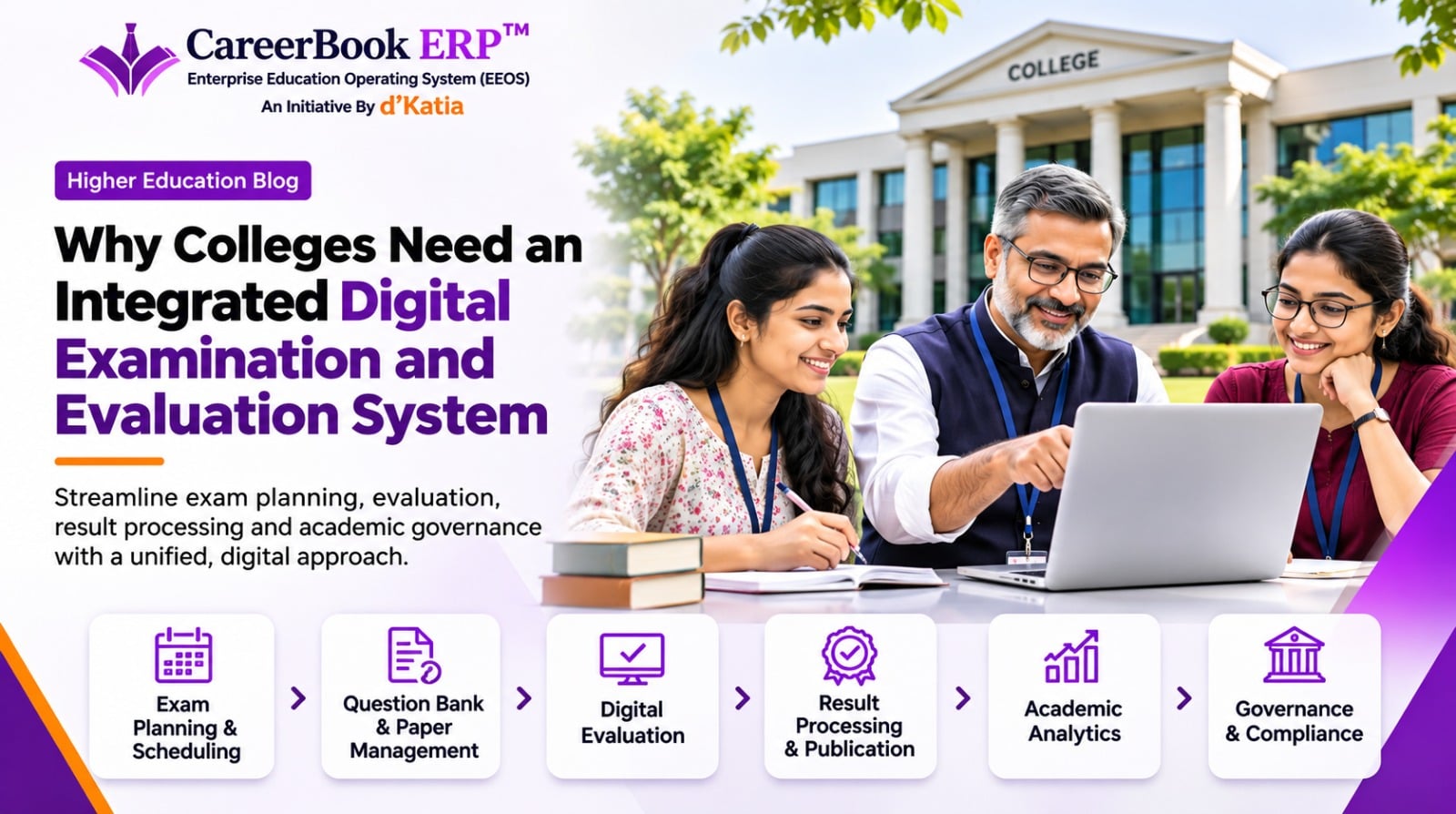
Why Colleges Need an Integrated Digital Examination and Evaluation System
Transforming examination planning, evaluation, result processing and academic governance through connected technology.
Key takeaways
- Disconnected examination tools add administrative work, delays and opportunities for human error.
- An integrated system manages planning, question papers, digital evaluation and result processing through coordinated workflows and shared data.
- Connected assessment data turns results into academic analytics that support informed institutional action.
- Examination management works best as part of a wider education operating system, not as an isolated application.
01The Challenges of Traditional Examination Management
College examination departments handle numerous interconnected responsibilities, often under strict academic deadlines.
Common challenges include:
- Preparing examination timetables across departments and programmes.
- Coordinating question paper preparation, review and approval.
- Maintaining confidentiality and controlled access to examination materials.
- Managing student eligibility, examination registration and hall tickets.
- Allocating evaluators and tracking assessment progress.
- Consolidating internal and external assessment marks.
- Identifying missing marks, discrepancies and processing errors.
- Preparing results, grade sheets and academic reports.
- Managing revaluation, supplementary examinations and historical records.
When these activities operate independently, information must frequently be transferred between departments or systems.
This creates additional administrative work, delays and opportunities for human error.
02What Is an Integrated Digital Examination and Evaluation System?
An integrated digital examination and evaluation system is a connected technology platform designed to manage multiple stages of the examination lifecycle through coordinated workflows and shared institutional data.
Instead of maintaining separate systems for student records, examination scheduling, evaluation, result processing and reporting, institutions can bring these functions together within a unified environment.
A comprehensive solution may support:
- Examination planning and scheduling.
- Student examination registration and eligibility verification.
- Question bank and question paper workflows.
- Examination administration.
- Digital evaluation of answer scripts.
- Internal and external marks management.
- Grade calculation and result processing.
- Revaluation and supplementary examinations.
- Academic reports and performance analytics.
- Role-based access, approvals and audit trails.
The objective is not simply to replace paper with digital screens. It is to create a more reliable and manageable examination process.
03Faster and More Organised Examination Planning
Examination planning involves coordination between academic departments, faculty members, examination cells and institutional administrators.
An integrated system can simplify this process by bringing examination schedules, student information, subject details and administrative workflows into one environment.
This helps institutions reduce repetitive work, improve coordination and identify scheduling or data inconsistencies earlier.
For colleges offering multiple programmes, semesters and examination patterns, configurable workflows are particularly valuable.
04Better Control Over Question Paper Management
Question paper preparation is a sensitive academic process that requires careful coordination and confidentiality.
Digital workflows can help institutions manage question banks, paper-setting assignments, review stages and approval responsibilities.
Where supported, institutions can also use structured question classification, access restrictions and controlled paper-generation processes.
However, technology must be supported by appropriate security controls, institutional policies and responsible academic oversight.
A digital system should strengthen examination governance without compromising the confidentiality or integrity of assessments.
05Digital Evaluation: Improving the Assessment Workflow
Evaluation is often one of the most time-consuming stages of the examination process.
Physical answer-script handling, evaluator allocation, marks entry and result consolidation can create significant operational demands.
A well-designed digital evaluation system can help institutions coordinate these activities more effectively.
Depending on the implemented solution, digital evaluation may include scanned answer scripts, electronic evaluator allocation, on-screen marking, assessment progress monitoring and structured marks submission.
Potential benefits include:
- Reduced physical movement of answer scripts.
- Better visibility into evaluation progress.
- More consistent marks-entry workflows.
- Easier monitoring of pending assessments.
- Improved traceability of evaluator activities.
- Faster identification of incomplete evaluation tasks.
Digital evaluation does not eliminate the need for academic judgement. Faculty members and authorised evaluators remain responsible for assessment quality and fairness.
06More Reliable Result Processing and Publication
Result processing involves much more than calculating total marks.
Institutions must apply approved grading policies, combine assessment components, validate records and address discrepancies before publishing results.
Disconnected systems can make this process difficult, particularly when marks are received from multiple departments or evaluators.
An integrated examination platform can support structured validation, authorised approvals and consistent result-generation workflows.
This can help examination departments reduce manual reconciliation and maintain clearer records of changes and decisions.
Final result publication should always follow the institution's approved academic regulations and verification procedures.
07Academic Analytics for Better Decision-Making
Examination information is valuable beyond result publication.
When assessment data is connected with academic records, institutional leaders can gain a clearer understanding of student performance and programme outcomes.
Useful reports may include:
- Subject-wise pass percentages.
- Semester and programme performance trends.
- Internal versus external assessment patterns.
- Department-wise result analysis.
- Students requiring additional academic support.
- Evaluation completion and pending-work reports.
- Historical examination performance comparisons.
These insights can help principals, heads of departments and academic committees identify areas requiring attention.
The real value of examination analytics lies in turning academic data into informed institutional action.
08Supporting Academic Governance and Accountability
Examination management requires clearly defined responsibilities, controlled access and reliable documentation.
An integrated platform can support institutional governance through role-based permissions, approval workflows, activity records and structured reporting.
These capabilities can make it easier to understand who performed an action, when it occurred and whether required approvals were completed.
Digital records may also support internal academic reviews, institutional quality-assurance activities and accreditation-related documentation.
However, software alone does not guarantee regulatory compliance or accreditation. Institutions must configure and operate their systems according to applicable requirements.
09Why Integration With the College ERP Matters
A standalone examination application may digitise individual activities while leaving important information disconnected from the rest of the institution.
For example, examination eligibility may depend on student enrolment records, attendance, academic regulations or other approved institutional criteria.
Similarly, examination results may need to connect with student academic histories, faculty records, institutional dashboards and reporting systems.
When examination management forms part of a wider education operating system, institutions can reduce duplicate data entry and improve coordination between academic and administrative functions.
This is why colleges should evaluate not only the features of an examination system but also how effectively it integrates with their existing institutional workflows.
10CareerBook ERP™: Connecting Examination Management With Institutional Operations
CareerBook ERP™ — Enterprise Education Operating System (EEOS) is designed to connect academic, administrative and institutional management processes through a unified platform.
Its broader education management approach brings together examination-related operations with student information, academic administration, institutional reporting and other relevant modules.
For colleges and universities, the value of this integrated approach is the ability to manage examination activities as part of a connected academic environment rather than as an isolated administrative function.
Institutions evaluating CareerBook ERP™ can explore the examination and digital evaluation capabilities applicable to their academic structure, assessment regulations and implementation requirements.
Specific workflows, integrations and configurations should be confirmed during the product demonstration and institutional requirements assessment.
Conclusion: Moving Towards a More Connected Examination Ecosystem
The future of college examination management is not defined by digitisation alone.
It depends on how effectively institutions connect examination planning, evaluation, result processing, academic records and institutional decision-making.
An integrated digital examination and evaluation system can help colleges improve coordination, strengthen oversight and reduce administrative complexity while maintaining academic responsibility.
For institutions planning their next stage of digital transformation, examination management is an important place to begin.
Explore Integrated Examination Management With CareerBook ERP™
Discover how CareerBook ERP™ can support your institution's examination administration, digital evaluation and academic reporting requirements.
Request a Personalised Demo
Request a personalised demoCareerBook ERP™Enterprise Education Operating System (EEOS)Website: www.careerbookerp.com
CareerBook Editorial Team
Insights for education leaders. Published by the CareerBook ERP team.