

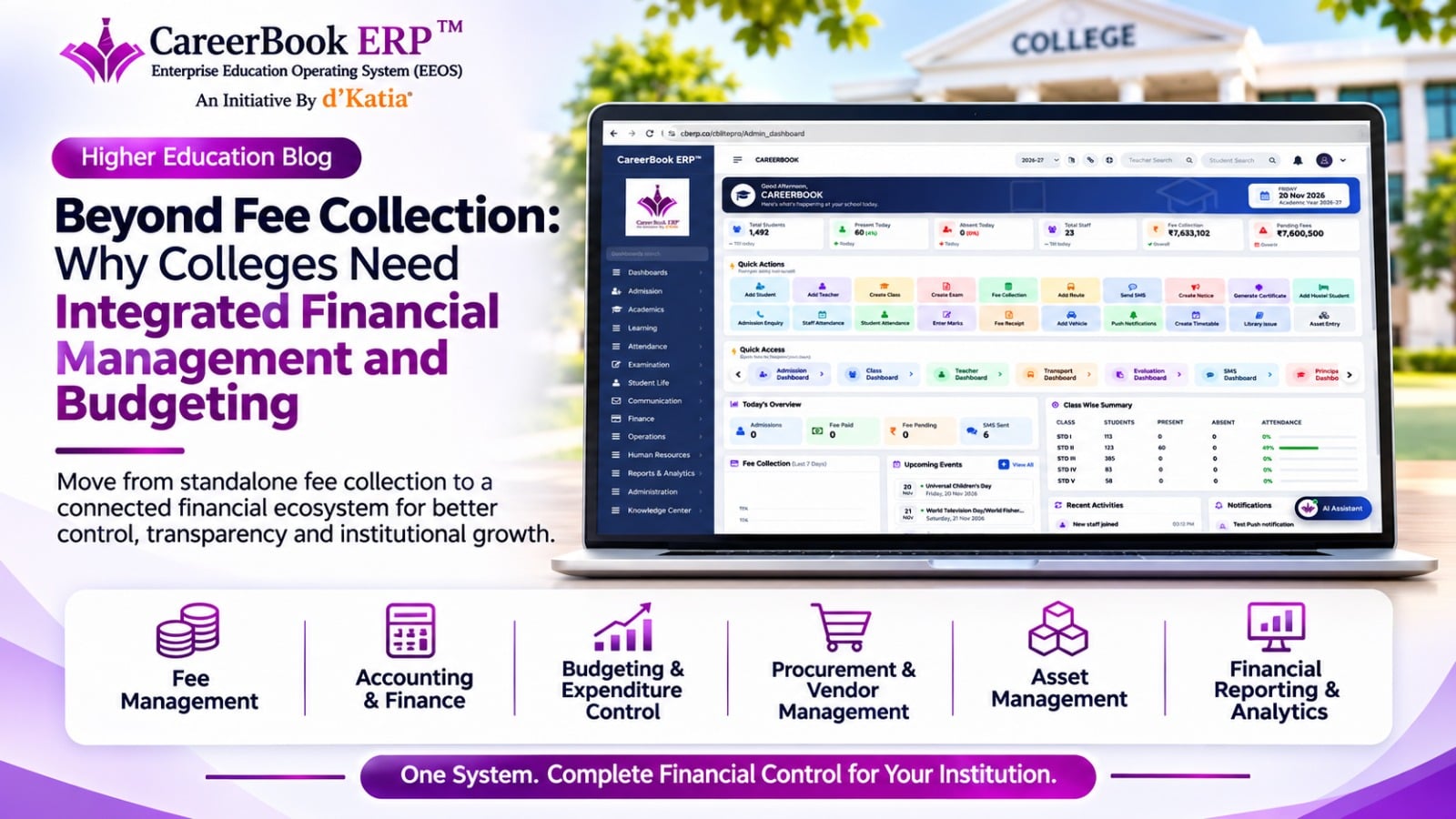
Beyond Fee Collection: Why Colleges Need Integrated Financial Management and Budgeting
From student fee collection to budgeting, procurement, expenditure control and financial intelligence — why modern educational institutions need a connected approach to financial management.
Key takeaways
- Fee collection is only one part of institutional financial management.
- Department-wise budgets, procurement, assets and accounting need to be connected to give leaders a complete financial picture.
- Executive dashboards show what has been collected, committed, spent and what remains available.
- Multi-campus groups need institution-level independence with consolidated, standardised reporting.
Introduction: Is Fee Collection Enough to Manage a College's Finances?
For many educational institutions, financial digitalisation begins with student fee collection.
Online payment gateways, digital receipts, automated reminders and outstanding fee reports have made collecting and monitoring student payments considerably easier.
But managing institutional finances involves much more than collecting fees.
A college must also manage departmental budgets, faculty salaries, operational expenditure, vendor payments, procurement, assets, infrastructure investments and financial reporting.
For institutions operating multiple campuses, the challenge becomes even more complex.
A college may have an efficient fee collection system and still struggle with financial visibility, budget control and institutional financial planning.
This is why modern colleges and universities need to move beyond standalone fee collection systems towards integrated financial management and budgeting.
01The Difference Between Fee Collection and Financial Management
Fee collection is only one component of institutional financial management.
A fee management system typically focuses on:
- Student fee structures and instalments.
- Fee collection and receipts.
- Outstanding balances.
- Payment reminders.
- Scholarships and concessions.
- Collection summaries and reports.
These functions are important, but they primarily address student-related revenue.
Institutional financial management takes a broader view.
It includes:
- Financial accounting and ledger management.
- Annual and departmental budgeting.
- Revenue and expenditure monitoring.
- Vendor and supplier payments.
- Purchase approvals and procurement.
- Payroll-related financial coordination.
- Fixed asset accounting and tracking.
- Cash flow planning.
- Financial reporting and reconciliation.
- Multi-campus financial consolidation.
When these activities operate independently, institutional leaders may find it difficult to understand their complete financial position.
An integrated financial management system connects these activities to provide a more coordinated view of institutional finances.
02Common Financial Challenges Faced by Colleges
Colleges and universities often manage financial information across several departments, systems and spreadsheets.
This can create significant administrative challenges.
Disconnected financial records
Student fee information may be maintained in one application, accounting records in another, and departmental expenditure in separate spreadsheets.
Finance teams must repeatedly reconcile information between these systems.
Limited budget visibility
Department heads may not have timely information about approved budgets, committed expenditure and available balances.
This can make financial planning difficult.
Manual purchase approvals
Purchase requests, quotations, approvals and vendor payments may involve several departments and manual documentation.
Without a connected workflow, it becomes harder to track purchasing decisions.
Delayed management reporting
Preparing consolidated financial reports can require significant manual effort, particularly when information comes from multiple campuses.
Inadequate expenditure monitoring
Management may know how much revenue has been collected but may not have equally clear visibility into how institutional funds are being utilised.
These challenges highlight the need for connected financial processes rather than isolated financial applications.
03Why Department-Wise Budgeting Is Essential
Every academic department requires financial resources to operate effectively.
For example:
- Science departments need laboratory equipment and consumables.
- Engineering departments require technical equipment and maintenance.
- Libraries need books, journals and digital subscriptions.
- IT departments manage software, hardware and infrastructure.
- Administrative departments require operational budgets.
- Academic departments may need funding for seminars, workshops and research activities.
Without structured budgeting, institutions may struggle to allocate resources according to academic and operational priorities.
An integrated budgeting system can help institutions establish:
Annual budgets
Define expected revenue and expenditure for the financial year.
Department-wise allocations
Assign budgets to individual academic and administrative departments.
Budget versus actual reports
Compare approved budgets with actual expenditure.
Budget utilisation tracking
Monitor how much of an allocation has been spent or committed.
Approval workflows
Route expenditure requests through authorised approval levels.
Budget revisions
Record approved changes to allocations when institutional requirements evolve.
Practical example
Consider a college laboratory department with an annual approved budget of ₹20 lakh.
During the year:
- Approved annual budget: ₹20 lakh
- Actual expenditure: ₹12 lakh
- Committed purchase orders: ₹3 lakh
- Remaining uncommitted budget: ₹5 lakh
A connected budgeting system can make this position visible to authorised department heads and financial administrators.
Instead of relying on periodic manual updates, management can review budget utilisation using current, properly recorded financial information.
Figures are illustrative.
04Connecting Student Fee Collection With Institutional Accounting
Student fee collection generates a significant portion of revenue for many educational institutions.
However, collecting a payment and recording it correctly in the institution's accounts are related but distinct responsibilities.
A connected system can help coordinate:
- Student fee demand creation.
- Fee collection and payment confirmation.
- Receipts and refunds.
- Scholarships, discounts and concessions.
- Payment gateway settlements.
- Bank reconciliation.
- Accounting entries.
- Revenue reporting.
Integration can reduce repeated data entry and make financial reconciliation more efficient.
For example, when a student pays a semester fee online, the payment information should be available to the relevant fee and accounting workflows according to the institution's configured financial policies.
The finance team should also be able to identify settlement differences, reversals and unreconciled transactions.
This helps maintain a more consistent connection between student fee records and institutional financial statements.
05Centralised Procurement and Purchase Management
Procurement is an important but sometimes overlooked component of educational financial management.
Colleges regularly purchase:
- Laboratory equipment.
- Computers and networking devices.
- Classroom furniture.
- Library resources.
- Office supplies.
- Maintenance materials.
- Software and technology services.
In larger institutions, multiple departments may independently request similar products.
A centralised procurement system can support better coordination.
A connected procurement workflow
- Department raises a purchase request.
- Authorised personnel review the requirement.
- Budget availability is checked.
- Quotations and vendor information are evaluated.
- Purchase approval is recorded.
- Purchase order is generated.
- Goods or services are received and verified.
- Supplier invoice is processed.
- Payment is authorised.
- Expenditure is reflected in financial reports.
This approach can improve documentation, purchasing visibility and accountability.
For groups of institutions, centralised purchasing may also create opportunities to consolidate common requirements and negotiate more effectively with suppliers.
The actual savings depend on purchasing volumes, supplier arrangements and procurement practices.
06Asset Management: Understanding Institutional Investments
Educational institutions invest substantially in physical and digital assets.
These may include:
- Buildings and infrastructure.
- Laboratory equipment.
- Computers and servers.
- Furniture.
- Vehicles.
- Library assets.
- Sports equipment.
- Technology infrastructure.
Asset management is not simply about maintaining an inventory list.
Institutions also need to understand asset ownership, location, utilisation, maintenance requirements and relevant financial information.
An integrated asset management process can support:
- Asset registration and classification.
- Department and campus allocation.
- Asset identification.
- Purchase and warranty information.
- Maintenance records.
- Asset transfers.
- Disposal records.
- Depreciation-related accounting, where configured.
Connecting procurement, asset records and financial accounting can provide a more complete picture of institutional investments.
This is particularly valuable for institutions operating several campuses or maintaining high-value laboratory and technology infrastructure.
07Financial Dashboards for Principals and Institutional Management
Financial reports should not be limited to accounting departments.
Principals, directors, finance officers and institutional leadership also need timely information to make informed decisions.
An executive financial dashboard can bring important indicators together.
Useful financial dashboard indicators
| Indicator | Management purpose |
|---|---|
| Total fee demand | Understand expected student fee revenue |
| Fee collection | Monitor recorded collections |
| Outstanding fees | Identify pending receivables |
| Budget utilisation | Compare spending with approved allocations |
| Department-wise expenditure | Understand where resources are being used |
| Vendor payables | Monitor outstanding supplier obligations |
| Cash flow | Review expected receipts and payments |
| Procurement commitments | Understand approved but not yet fully paid purchases |
| Asset expenditure | Track capital investments |
| Campus-wise financial summary | Compare financial positions across institutions |
The value of these dashboards depends on accurate data, appropriate accounting rules and timely updates.
A well-designed dashboard should allow authorised management users to move from a summary indicator to the underlying financial details.
Financial intelligence begins when institutional leaders can understand not only what has been collected, but also what has been committed, spent and remains available.
08Multi-Campus Financial Management: A Growing Requirement
Educational groups may operate multiple colleges, schools, training centres or campuses under common management.
Each institution may have its own:
- Revenue sources.
- Expenditure.
- Budgets.
- Employees.
- Vendors.
- Assets.
- Financial responsibilities.
At the same time, the head office needs consolidated visibility.
Without integrated systems, management teams may depend on periodic reports submitted independently by each institution.
This can delay financial reviews and make comparisons difficult.
A multi-campus financial management system can support:
Institution-level financial independence
Each campus maintains its authorised financial records and operational responsibilities.
Centralised management visibility
Head office users access approved consolidated reports.
Standardised financial reporting
Institutions follow consistent reporting structures where appropriate.
Group-level budgeting
Management reviews allocations and financial performance across institutions.
Centralised purchasing
Common procurement requirements can be coordinated across campuses.
Consolidated financial analysis
Leadership can review group-level information while retaining the ability to examine individual institutions.
Such capabilities are especially relevant to educational trusts, societies, university groups and multi-institution organisations.
Consolidation must follow the applicable accounting structure and should not be treated as a simple addition of balances where inter-entity adjustments or other accounting treatments are required.
09Financial Governance, Transparency and Accountability
Financial management is closely connected with institutional governance.
Educational institutions must maintain appropriate controls over financial transactions, approvals, accounting records and reporting.
An integrated financial platform can help support these responsibilities through:
- Role-based access permissions.
- Defined approval hierarchies.
- Transaction records.
- Financial audit trails.
- Budget controls.
- Reconciliation workflows.
- Standardised financial reports.
- Supporting document management.
For example, a department head may be authorised to submit a purchase request but not approve its payment.
Similarly, finance officers may have different responsibilities for recording, reviewing and authorising transactions.
Separating responsibilities helps strengthen internal financial controls.
Digital systems can support these practices, but they do not replace professional accounting oversight, institutional policies or statutory compliance responsibilities.
10Moving From Financial Reporting to Financial Intelligence
Traditional financial reports generally explain what has already happened.
For example:
- How much fee revenue was collected last month?
- What was the total expenditure?
- Which departments exceeded their budgets?
- How much is payable to vendors?
These are important questions.
However, institutional leaders also need to plan for future financial requirements.
More advanced financial analysis may help institutions examine:
- Historical collection trends.
- Expected fee receipts.
- Seasonal cash flow patterns.
- Departmental spending trends.
- Budget utilisation forecasts.
- Upcoming financial commitments.
- Potential funding gaps.
Where supported by suitable data and analytical capabilities, institutions may also explore predictive models and scenario-based financial planning.
Such forecasts are estimates rather than guarantees and should be reviewed by qualified financial personnel.
The objective is to move from reactive reporting towards more informed financial planning.
11CareerBook ERP™: An Integrated Approach to Institutional Financial Management
CareerBook ERP™ — Enterprise Education Operating System (EEOS) is designed to connect academic, administrative and institutional operations through a unified platform.
Its enterprise-oriented approach includes financial and operational management capabilities relevant to colleges, universities and educational groups.
These include:
- Student fee management.
- Financial accounting.
- Budgeting.
- Purchase and inventory management.
- Vendor-related workflows.
- Asset management.
- Human resources integration.
- Institutional reporting.
- Group and multi-campus management.
- Executive dashboards and analytics.
By connecting these functions, CareerBook ERP™ aims to help educational institutions manage financial activities within a broader institutional operating environment.
For example, an institution may evaluate how fee collection connects with financial records, how purchase approvals relate to departmental budgets, and how campus-level information contributes to management reports.
The specific workflows, integrations, reporting capabilities and configurations available to an institution should be confirmed during product demonstrations and implementation planning.
CareerBook ERP™ also supports institutional requirements through configurable workflows and implementation-specific customisation, subject to the agreed scope.
The goal is to help institutions move towards a more connected and manageable financial environment.
12Five Steps Towards Better Financial Management in Colleges
Colleges considering financial digital transformation can begin with a structured approach.
Step 1: Evaluate existing financial systems
Identify which applications and spreadsheets currently manage fee collection, accounting, budgets, purchasing and assets.
Look for duplicated records and disconnected processes.
Step 2: Establish clear financial policies
Define budgeting procedures, approval responsibilities, accounting practices and reporting requirements.
Step 3: Connect core financial workflows
Prioritise integration between fee management, accounting, budgeting and procurement.
Step 4: Introduce management dashboards
Provide authorised decision-makers with relevant financial summaries and drill-down reports.
Step 5: Review financial performance regularly
Use monthly and quarterly financial reviews to monitor budget utilisation, expenditure, receivables, commitments and cash flow.
Technology becomes most valuable when financial information is used consistently to improve institutional planning and accountability.
Conclusion: Financial Management Must Go Beyond Fee Collection
Digital fee collection has improved an important part of educational administration.
But the financial responsibilities of a college extend far beyond receiving student payments.
Institutions must plan budgets, control expenditure, manage procurement, monitor assets, maintain reliable accounts and provide management with timely financial information.
When these activities are disconnected, financial administration becomes more complex and institutional visibility may be limited.
The future of college financial management lies in connecting revenue, expenditure, budgeting, procurement and institutional governance within a coordinated digital environment.
For colleges and universities seeking stronger financial control and sustainable institutional growth, integrated financial management is an important foundation.
Bring Financial Intelligence to Your Institution
Explore how CareerBook ERP™ can help connect fee management, accounting, budgeting, procurement, asset management and institutional reporting.
Request a Personalised Demo
Request a personalised demoCareerBook ERP™Enterprise Education Operating System (EEOS)Website: www.careerbookerp.com
CareerBook Editorial Team
Insights for education leaders. Published by the CareerBook ERP team.